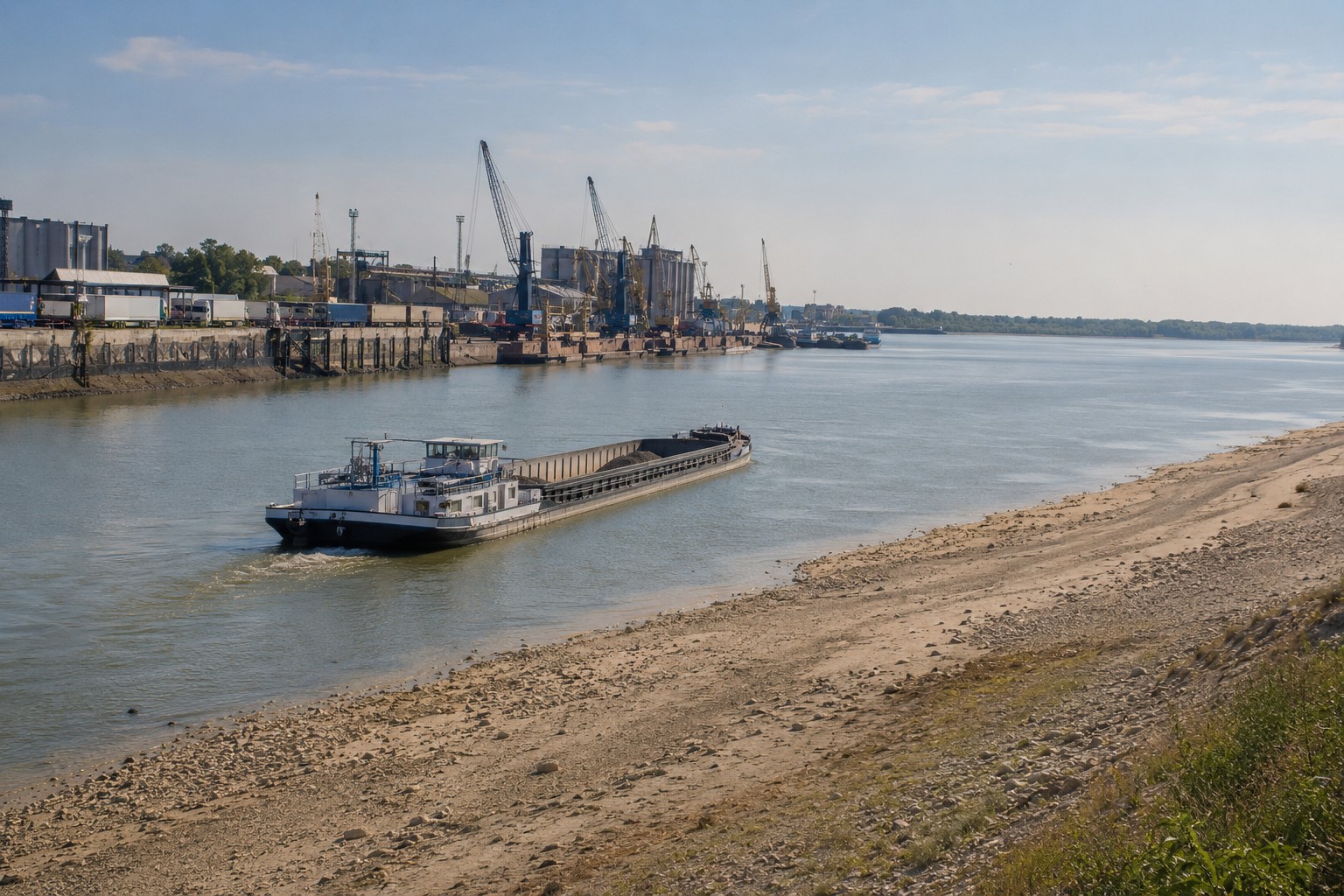
Photo: Ruse Chamber of Commerce and Industry
Author: Svetoslav Minchev, PMP, Ruse Chamber of Commerce and Industry
Short teaser
Prolonged drought is restricting cargo capacity on the Danube and Rhine and shifting pressure to road and rail. For Bulgarian and European companies, the result is not only more expensive logistics, but also the need for a new approach to managing deliveries, inventories and contractual risk.
Low water on the Danube can no longer be treated as a seasonal inconvenience affecting a handful of ports. It is becoming a European business risk because it simultaneously affects transport capacity, delivery times, input prices and working-capital requirements. As of 11 August 2026, the Executive Agency for Exploration and Maintenance of the Danube River reported a level at Ruse of 114 centimetres below the local gauge zero and a discharge of 1,541 cubic metres per second. The negative figure does not mean that the river has no physical depth. It measures the deviation from the local reference datum and signals the severity of constraints at critical sections.
Navigation on the Bulgarian stretch has not stopped completely, but the low level reduces permissible draught and the amount of cargo each vessel can carry. In early August, numerous convoys were waiting to pass, while restrictions around Batin and Belene islands narrowed usable capacity. The economic impact begins long before a river becomes unnavigable: moving the same volume requires more voyages, additional vessels or transfers to rail and road.
For Bulgaria, this is a national issue rather than a problem confined to Ruse. The Danube connects the country's river ports with Central Europe and the Black Sea and supports flows of agricultural products, raw materials, fuels and industrial inputs. When river capacity falls, the cost travels through the supply chain: transport and transshipment become more expensive, lead times become less predictable, companies hold larger inventories, and more cash remains tied up in materials and goods in transit. Even firms that do not use river transport directly may be exposed through suppliers, customers or logistics providers.
The same problem is unfolding along the broader European corridor. In July, the Danube's discharge as it entered Romania fell to about 1,700 cubic metres per second, compared with a normal July range of roughly 4,700. Levels reached their lowest point since 1996, some ferry connections were suspended and grain barges were left idle. The episode demonstrates how one hydrological shock can affect logistics, agriculture, tourism and water-resource management at the same time.
At the same time, low water created severe pressure on the Rhine, a key artery for Europe's chemical, energy and manufacturing industries. German carriers warned that critically low levels at Kaub could temporarily halt freight traffic on a key stretch. Several German states relaxed restrictions on heavy trucks to ease the shortfall in transport capacity. When the Danube and Rhine are constrained simultaneously, alternative roads, railways and terminals also become congested. Competition for scarce capacity then raises prices far beyond the river regions themselves.
The timing is particularly difficult for Bulgarian manufacturers. According to Eurostat, domestic industrial producer prices in Bulgaria were 18.2% higher in June 2026 than a year earlier, compared with an EU average increase of 4.7%. Low water did not cause the increase already recorded, but it is emerging in an environment where many companies have limited room to absorb another layer of logistics costs. This raises the likelihood that the additional burden will either be passed on to customers or reduce margins and investment capacity.
A practical response starts with visibility across the entire supply chain. Companies need to identify not only their direct river shipments, but also the dependencies of key suppliers. For critical materials, it is useful to define in advance the thresholds that will trigger a switch to an alternative route, such as a specified delay, draught restriction or increase in total cost. Comparisons should cover the full cost from consignor to consignee, including transfers, time, damage risk and the additional working capital required.
Contract reviews, selective buffer stocks, cash-flow scenarios and early customer communication are also necessary. Low water should not automatically be treated as force majeure, because the allocation of risk depends on the specific contract clauses, delivery terms and applicable law. Larger inventories are not a universal answer either: they reduce the probability of disruption, but tie up cash and create storage costs.
Adaptation cannot remain the responsibility of individual companies alone. In March, experts from the Danube Commission, the European Commission, national waterway administrations and the shipping industry stressed that longer low-water periods and greater hydrological volatility are already reshaping operating conditions. The response requires coordinated fairway maintenance, timely dredging, reliable real-time data, stronger connections between river, rail and road transport, and investment in vessels capable of operating at shallower draughts. A single bottleneck can weaken the reliability of the entire corridor.
Low water does not automatically stop European trade, but it changes transport economics well before a complete shutdown. For businesses, resilience now means understanding hidden dependencies, maintaining workable alternatives and incorporating climate risk into decisions on contracts, inventories, liquidity and investment. For Bulgaria, it is also an opportunity to treat modernisation of the Danube corridor as a core condition for competitiveness, rather than a seasonal transport problem.
Note: Information is current as of 11 August 2026. Hyperlinks in the text lead to the main sources.