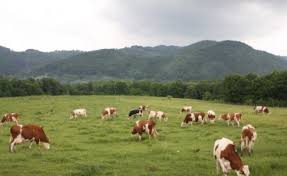
The livestock breeding is one of the two main branches of agriculture. It deals with breeding and rearing of livestock and receives the output of them. It is not seasonal, but is heavily dependent on the plant production ensuring food for animals. An important feature is the biological nature of the production, which connects economic and natural process of reproduction. Over the past 30 years the livestock breeding has developed mainly in productive direction, which considerably increases the importance of the sector. The place of the sector is determined by its share in the total agricultural production, the share of employment, the participation in the country's exports and a number of other indicators.
At the end of 2013 the number of farms in the country increased by 12% compared to the previous year, reaching 171 800. The most significant increase was in the pig farms with 91.6%, mainly due to the increased farms with 1-2 pigs. Less pronounced was the increase in farms with cattle, buffalo and goats - by between 2.2 and 6.6 percent. Only sheep farms decreased by 2.3%. Compared to the previous year the number of most livestock species also increased. In 2013 the process of consolidation of farms continued, which was a prerequisite for achieving high efficiency and economic stability. Compared to the previous year the most significant increase in the average number of animals in a farm was reported in the farms breeding buffaloes - with 33.2%.
By 31 December 2013 the total number of birds in the country amounted to 13.213 million, 13.4% less compared to a year earlier. About other species of birds - turkeys, geese and other (quail, ostrich and guinea fowl), which normally form a minor share of the total number of birds in the country, a decrease between 8.5 and 20.8 percent was reported.
Bulgaria has a long tradition in the production of honey and bee products, which is a result of the rich diversity of vegetation and diverse landscape of the country. The appropriate natural, climatic and environmental conditions that contribute to the gradual increase in the yield of these products have a favourable influence. The beekeeping provide alternative employment for the population of the less developed rural areas providing additional income.
Recently the interest in breeding rabbits in the country is increasing, which is determined by the best natural climatic conditions, the tradition and the experience in rearing and the increased demand for alternative meats worldwide. Large part of the farmers raised rabbits for their own consumption. According to the preliminary data from the BFSA at the end of 2013 the total number of rabbits in the country was about 95,000 - approximately the level of the previous year.
In the organic livestock the positive trend continued in 2013. The management of genetic resources in livestock breeding seeks to protect threatened and endangered local autochthonous breeds - national wealth of the country, as well as maintenance and development of commercial breeds forming national genetic resources. In the 2009 - 2013 period there were no species with a decreased status of endangerement and extinct species.
Support schemes in the livestock breeding sector
In 2013 the livestock breeding sector was stabilized, for which contributed the applied and consistent policy of support. The stable interest in the applied and financed by the national budget and EU payment schemes per animal continues. From the funds provided by the State Fund Agriculture and by the State aid schemes (no de minimis) in 2013, BGN 59.7 million were in the livestock breeding sector. Full utilization of the budget was reported on both measures 121 "Modernization of farms" suitable for farmers who produce unprocessed agricultural products of animal husbandry, including unprocessed products resulting from the breeding and measure 112 "Establishment of holdings of young farmers" that is suitable for enterprises from the Food Industry, and used as raw materials entering must come in the form of live animals killed, and its sub - products. The qualitative analysis of projects under measure 112 "Establishment of holdings of young farmers", in which payments were made, showed that 9% of projects were in the field of animal husbandry. In 2013, under the "Livestock" 4 projects were financed with an investment value of BGN 204 654. The provided credit funds amounted to BGN 129 090. Under the program subsidies were paid during the year to cover interest expenses for BGN 127 557, representing commitments for projects approved in previous years. Currently both aid programmes of this type operate– animal welfare for birds and pigs, which in 2013 were granted a total of BGN 45.4 million with disbursements for BGN 38.9 million or 86% of the prescribed resource. Schemes have been developed for the applying of higher standards for animal welfare in holdings that have been sent for approval by the European Commission. The greatest increase in the number of beneficiaries was observed in specific support schemes for breeding ewes and goats.
The value of gross production from sector "Agriculture" for 2013 at current producer prices (preliminary data) amounted to BGN 8 713.8 million, which was by 0.5% below the previous year. In 2013, the value of livestock production was 2 350.2 million BGN or 27.0% of total gross production from sector "Agriculture". A decline compared to the previous year was recorded, which was largely driven by price factors and in the industry as a whole an increase in the volume of production was reported, which however was accompanied by a substantial fall in producer prices.
Source: Bulgarian Investment Agency