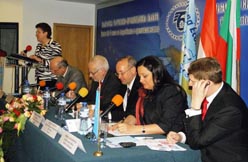
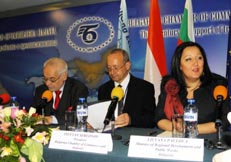
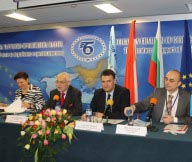
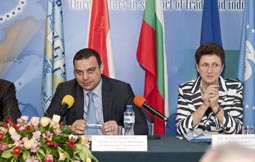
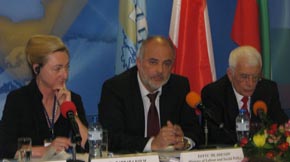
The Bulgarian Chamber of Commerce and Industry hosted Vienna Economic Talks, Sofia meeting, thus allowing Bulgarian business to participate in a conference dedicated to the extremely topical for South Eastern Europe issue – “Liberalisation of Regional Markets” with main accent put on liberalisation of the energy markets, liberalisation of the labour market and the experience of foreign investors in the region. The interesting themes discussed at the conference attracted great attention of over 180 participants from 16 countries. The event was opened by H.E. Dr. Elena Kirtcheva, Secretary General of Vienna Economic Forum and Ambassador of the Republic of Bulgaria to Austria.
Vienna Economic Talks were held under the auspices of the Prime Minister of the Republic of Bulgaria Boyko Borisov, who is a member of the Committee of the Patrons of Vienna Economic Forum. In the beginning of the event, a welcome address by the Prime Minister of the Republic of Bulgaria was read. The address emphasized that Sofia hosts this high forum for the second consecutive year, which is significant of Bulgaria’s important role for promoting and enhancing economic cooperation in South Eastern Europe. Liberalisation of the regional markets concerns both the energy consumers, producers and traders, it was pointed out. At present, about 27% of trade in the country is carried out in compliance with the requirements of the free market, the statement read. The programme of the Government is targeted at increasing the share of freely negotiated electricity on the internal market to 30% in 2013.
H.E. Mr. Gerhard Reiweger, Ambassador of the Republic of Austria to Bulgaria also pointed out that Vienna Economic Forum is among the leading forums in the Danube Region and introduced the participants to the Forum’s history and activities.
Dr. Erhard Busek, President of Vienna Economic Forum and Former Vice Chancellor of Austria, emphasized the role of the Central European Free Trade Agreement (CEFTA) and outlined the prerequisites for liberalisation of the regional markets (infrastructure, education, etc.) as well as the key instruments (Regional Cooperation Council – the successor of the Stability Pact for South Eastern Europe and the EU Strategy for the Danube Region).
Ministers and Deputy Ministers, representatives of international organizations and NGOs took part in the discussions.
Highlights from the speeches HERE
BCCI’s forum was dedicated to an extremely well-selected topic, due to the partners that organized the event – Vienna Economic Forum and the Bulgarian Chamber of Commerce and Industry. The topic concerns everyone, said the President of BCCI Tsvetan Simeonov. At a moment when we strive to make Europe more competitive and attractive, the liberalisation of the regional market is of utmost importance, he added and drew the following conclusions:
- Most of the EU Member States regard South Eastern European countries an integral part of the common economic area.
- Regional cooperation is a medium in which bilateral and multilateral relations find support and opportunities for realization in important economic fields – energy, infrastructure, labour market, etc.
- Undoubtedly, the cooperation process in South Eastern Europe remains the main format for regional cooperation
- Implementation of significant projects in priority sectors will be of great importance for the region’s prosperity. Bulgaria develops concrete projects and programmes of regional importance in order to improve the cooperation with its Balkan neighbours.
- The intention of the mobile operator “MobilTel” to invest in the setting up of internet infrastructure in remote and smaller towns and villages, declared at the forum is another prerequisite for investors to widely benefit from the zero income tax incentive for companies, which invest in municipalities where unemployment levels exceed the country’s average unemployment rate. At present, almost 100 municipalities fall under this category.
- We realize that the complex economic processes taking place cannot but affect the strength and effectiveness of regional cooperation. However, we do not question the European perspective for all countries in the region.