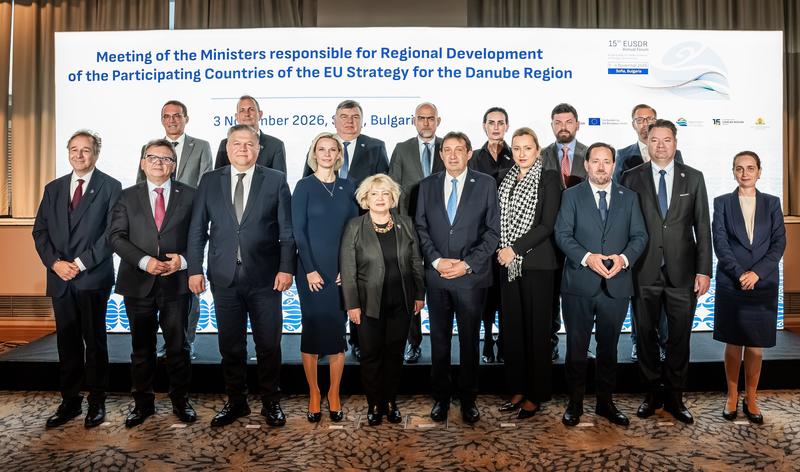
Strengthening cross-border cooperation, improving connectivity and addressing shared security and climate challenges are the main priorities at the 15th Annual Forum of the European Union Strategy for the Danube Region (EUSDR), which opened in Sofia on November 3.
The two-day forum, held on November 3 and 4, brings together representatives of European and national institutions, the 14 countries participating in the Danube Strategy, regional and local authorities, academia, civil society and young people. Discussions cover transport and multimodal connectivity, skills and local economies, water management, climate resilience, security and the role of small and medium-sized cities in balanced territorial development.
Particular attention is being paid to the future of EU cohesion policy after 2027 and the role of macro-regional strategies in the Union's future policies and financial instruments.
Bulgaria holds the Strategy's rotating presidency this year under the motto “Bridging Regions, Building Cohesion: A Stronger Danube for All”. Its priorities include reducing economic, social and territorial disparities and promoting more balanced development across the region.
Deputy Prime Minister Atanas Pekanov said the Danube Region brought together some of Europe's most developed economies and territories still facing structural problems, including gaps in infrastructure, investment and economic opportunities.
The next EU budget should help address these differences by supporting competitiveness, infrastructure and connectivity, he said. Pekanov stressed that cohesion funding remained essential and called for greater flexibility in the next financial framework to reflect the different needs of individual regions.
Europe could not afford to concentrate economic activity in only a few locations, as all regions had development potential, he said. Better connectivity, innovation and investment in social and educational activities could bring the Danube Region closer to the EU's leading regions while giving people opportunities to build their futures where they live.
Regional Development and Public Works Minister Ivan Shishkov said the Danube was one of the most natural links between the countries in the region, but much work remained to turn it into genuine economic connectivity. More bridges and modern ports were needed to make the river a driver of development, particularly in areas facing population decline and reduced economic activity.
Shishkov also called for shared responsibility in managing the river, noting that climate change was already affecting navigation, agriculture and industry. Decisions taken by one country could have consequences for other sections of the Danube, he said, stressing the need for coordinated action.
“There are challenges that some of our countries cannot address on their own. We have accumulated experience, but the question before us is how to make this cooperation more useful to people. Better connectivity should translate into innovation and jobs,” he said.
Interior Minister Ivan Demerdzhiev said security was an indispensable prerequisite for regional development. “Before talking about economic growth, we must put security on the agenda,” he said, pointing to organized crime, hybrid threats and illegal migration as challenges requiring joint action and interoperability.
He highlighted the work of the Danube Strategy's Priority Area “Security”, jointly coordinated by Bulgaria and Bavaria, as a platform for cooperation and operational results among law enforcement authorities. The fourth Conference of Interior Ministers of the Danube Region, held in June, reaffirmed commitments to deepen police cooperation, improve border controls and combat serious crime, he said.
Demerdzhiev also cited a September seminar in Sofia on combating domestic violence, attended by representatives of 11 Danube countries. The region's resilience and prosperity depended on citizens feeling protected, he said, adding that political commitments must lead to concrete action.
Juraj Droba, Chair of the Bratislava Self-Governing Region and Vice-President of the European Committee of the Regions, called for local and regional authorities to have a role not only in implementing European decisions but also in setting priorities and developing solutions.
The Danube connects people, markets and ideas from the Black Forest to the Black Sea, creating a shared European space whose challenges transcend national borders, Droba said. Better integration of river and maritime transport required coordination among ports, navigation systems and traffic management, while closer cooperation could create opportunities for cross-border business and innovation.
Droba said territorial cooperation should remain an important part of the EU's next multiannual financial framework and cohesion policy, with regional priorities translated into local investment. He also highlighted the Danube Strategy's contribution to EU enlargement by bringing Member States and candidate countries together around common challenges. For Ukraine and Moldova, participation offered practical experience relevant to their future EU membership, he said.
Citing the low water levels recorded on the Danube this summer and their impact on transport and the economy, Droba said the Bratislava Region's priorities for the next EU budget included human capital and water management.
In a video address, European Commission Executive Vice-President for Cohesion and Reforms Raffaele Fitto said cooperation among Danube countries was more important than ever given shared challenges related to demographic change, water management, competitiveness, mobility and security. Macro-regional cooperation brought tangible added value to Europe, he said, adding that the EU was strongest when countries acted together across borders, including Member States and those seeking EU membership.
The Commission's Director-General for Regional and Urban Policy, Themis Christophidou, said cohesion policy must continue supporting regions so that people, particularly young people, were not forced to leave because of a lack of jobs and development opportunities. Freedom of movement should go hand in hand with the opportunity to stay and prosper at home, she said.
Christophidou described climate change as a structural risk to the region's economy, connectivity, environment and security. Wildfires, pressure on water systems, glacial retreat and exceptionally low water levels in the Danube basin this summer underscored the need for cooperation on sustainability and disaster preparedness, she said.