Ministry of Economy, Investments and Industry Discusses Bulgaria’s Modernization with European Bank for Reconstruction and Development
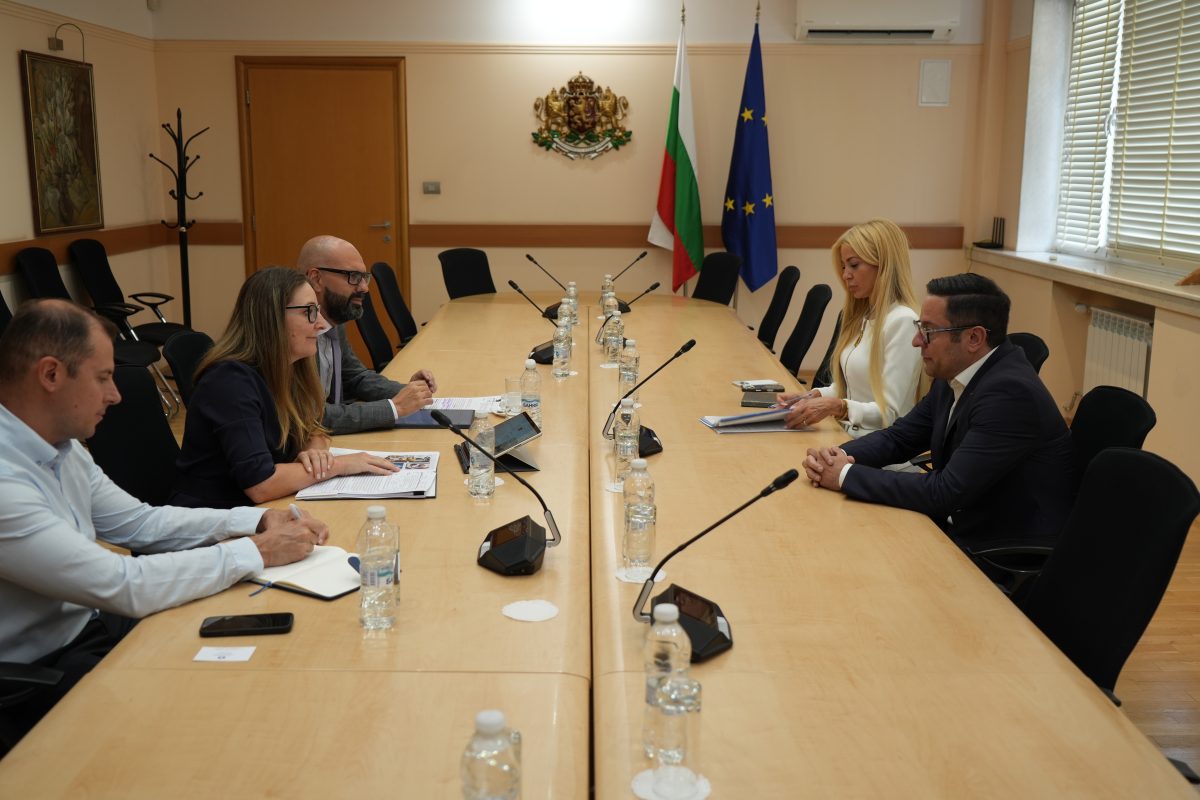
Phto: Ministry of Economy, Investments and Industry
Deputy Prime Minister and Minister of Economy, Investments and Industry Alexander Poulev discussed closer cooperation on Bulgaria’s modernization with European Bank for Reconstruction and Development (EBRD) representatives, the Ministry said on August 25.
The talks covered greater use of public-private partnerships, preparation of strategic infrastructure projects, European and international financial instruments, investment attraction, and the application of EBRD’s international practices and expertise.
“We have a clear goal: more investment, modern infrastructure and greater private-sector involvement. EBRD is Bulgaria’s natural strategic partner in this process, and we want to turn this dialogue into specific projects and tangible results,” Poulev said.
Poulev presented the main economic priorities in the Government’s programme, placing investment attraction first.
“Our focus is on high-value-added production and strategic partnerships with established companies in priority sectors because the current economic model has run its course. It relies heavily on debt-financed consumption, which is not sustainable. We must therefore restructure the economy and begin an economic transformation. This will take time, but we must lay the foundations and take the required administrative steps,” Poulev said.
Poulev identified better administrative services and a stronger business environment as the second priority. The aim was to improve coordination among institutions while reducing the administrative burden and business regulation. The Government also created a central coordination unit to link institutions and facilitate interaction with investors and international financial institutions.
Public-private partnerships and infrastructure modernization formed the third priority. Poulev said the Ministry was preparing an entirely new draft Public-Private Partnerships Act based on European practices.
“Public-private partnerships are one of the key tools we can use to mobilize private capital and accelerate infrastructure modernization in Bulgaria,” Poulev said.
The new framework will apply broadly, from industrial zones and transport connectivity to energy infrastructure and other strategic facilities.
“These projects require considerable resources and a long-term vision. This is where public-private partnerships can provide the tools we need,” Poulev said.
The aim was to attract additional private capital, including by combining it with EU funding and other financial instruments.
The participants also discussed EBRD’s potential to provide expert assessments and international experience in structuring projects. Poulev described the bank as one of Bulgaria’s most important institutional and financial partners over the years.
Poulev said cooperation with EBRD could extend beyond traditional financing to cover the entire project cycle.
“I believe our partnership can bring tangible improvements in the management, preparation and implementation of strategic investment projects. We want to apply the best international policies and standards and do even more to modernize Bulgaria,” Poulev said.
“EBRD is the gold standard in international finance among development banks,” Poulev said at the June 18 opening of the bank’s TechSofia centre in Sofia. “You are a key investor and one of the largest institutional financial partners of a number of Bulgarian governments. You are one of the Bulgarian State’s oldest friends in terms of the full range of growth instruments,” Poulev added. EBRD Vice President for Banking Matteo Patrone also attended the opening.
Between 1991 and June 2026, EBRD invested more than EUR 5 billion in over 320 projects in Bulgaria across sustainable infrastructure, finance, industry, trade and agribusiness. Its investments reached EUR 300 million in 2025, with a further EUR 200 million invested by June 18, 2026. Its five-year strategy for Bulgaria prioritized the green transition, competitiveness, economic resilience and regional integration.
EBRD supported public-private partnerships in infrastructure as a means of addressing public budget constraints and improving connectivity. In September 2025, the bank backed the Vasil Levski Airport concessionaire with a EUR 50 million loan for the airport’s expansion and its planned transition to carbon neutrality by 2036.